



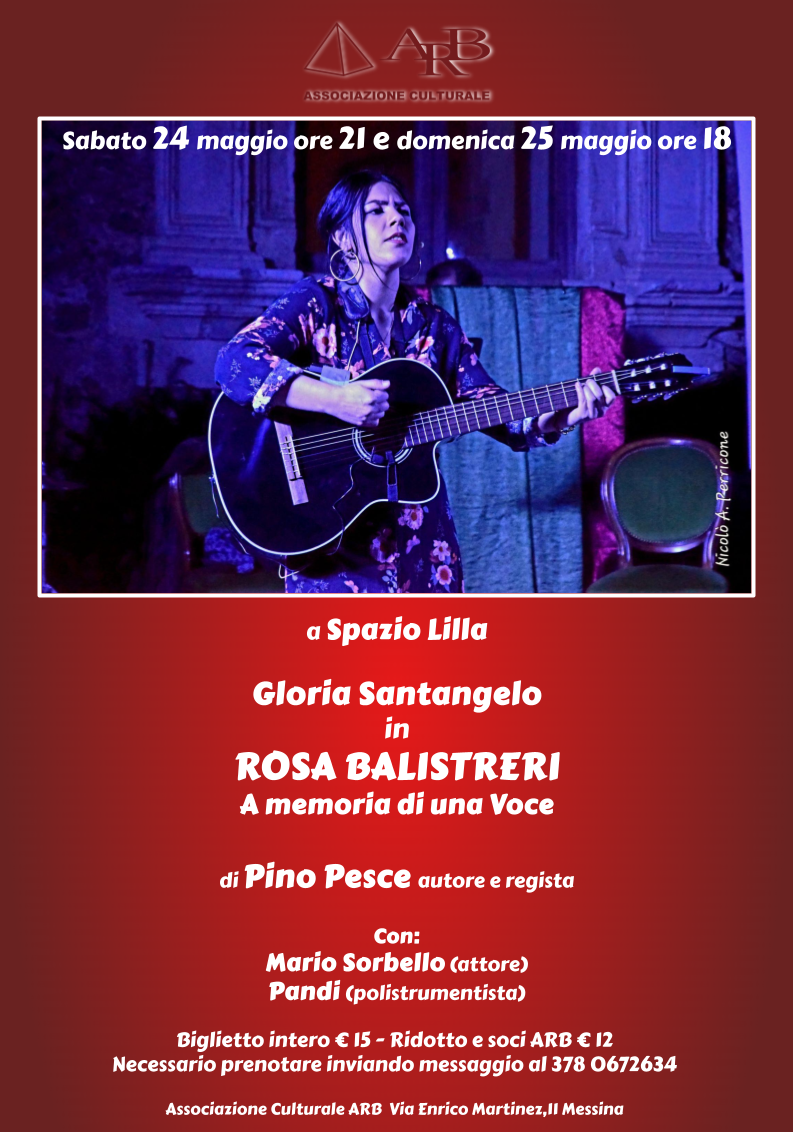
“Rosa Balistreri/ In Memory of a Voice” by Pino Pesce
After years of discussing Rosa Balistreri throughout Sicily, together with Giuseppe Cantavenere, biographer of the great Licata native, and Nello Correale, renowned director and author of the documentary film "La voce di Rosa," Professor Pino Pesce decided to adapt it for the stage: Rosa Balistreri/ In memoria di una Voce.
The plot is reported by combining the contributions of Rosa the character (young, old, storyteller and storyteller) and the Narrator: "Rosa Balistreri, in front of a tape recorder, shortly before her death in Montecatini Terme, tells the lawyer Giuseppe Cantavenere with poignant passion her life in a forgotten and violent Sicily. Rosa knows hunger and humiliation; a brutality worthy of Greek tragedies. She is strong; she doesn't cry; she curses and sings to free herself from an unkind fate.
At that time, in almost every house, mules, donkeys, chickens, goats, and other animals lived with the people […] Rosa, in her youth, had had beautiful dreams of love, which had given her moments of happiness, but adverse fate shattered them; thus, she had no choice but to suffer the bad luck of a lazy and violent husband, until she decided to leave him and turn over a new leaf. A period of illusions, disappointments, joys, and bitterness followed in Palermo, culminating in prison, which led her to leave Sicily and try a new life, wherever the first train would take her. Her destination was Florence.”
In Dante's city, life even smiles on her; she begins to perform her first public performances. Then, unexpectedly, she meets Dario Fo, and a career begins for her alongside some of the biggest names in entertainment; she tours in Italy and abroad. Her voice elevates the folklore of her homeland.
Twenty years of success, then her return to Sicily, where, even though she was almost illiterate, she managed to earn the respect of many intellectuals, including Sciascia, Buttitta, and Guttuso. After another twenty years in Sicily, where her singing, acting, and passionate and intelligent exploration of folk tunes and ancient songs buried under the dust of time, thanks to her, gained light and became poetry, Rosa returned to Tuscany, the land that forty years earlier had welcomed her, redeeming her from poverty, injustice, and violence. Rosa's mother had chosen to come to Florence to die. This poor woman had lived a hard and painful life: her husband "kept her locked in the house like a prisoner and wouldn't even let her look out the door. Out of this jealousy, Rosa's father, for many years, had constantly forced his family to move from one town to another; they traveled like gypsies: Palma di Montechiaro, Campobello di Licata, Riesi, Butera. He would call a cart; he would load it with hammers, nails, saws—in short, all the workshop tools—and the entire family, come wind, rain, or shine. In the town they arrived in, they would look for a warehouse and a few stubbles on the ground would suffice as a bed. In that single space, they cooked, ate, and relieved themselves.
This story, translated into Sicilian, is also sung by Rosa in the manner of storytellers with the traditional video projection poster that, in painted panels, tells the most significant events, which are enlivened by sketches of Rosa's youth and by twists that maximally dramatize the development.