



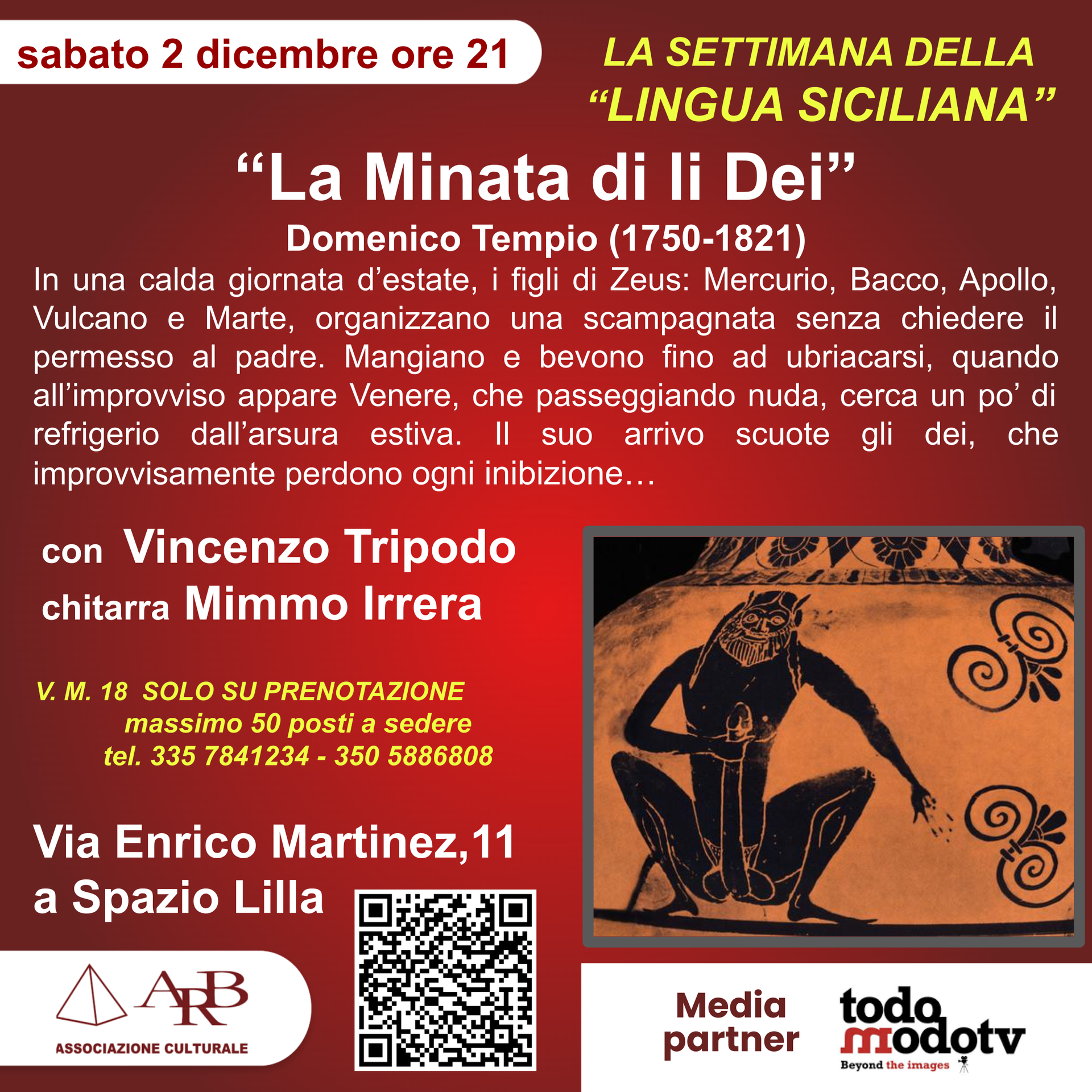
THE MINATA OF LI DEI
On a hot summer day, Zeus's sons—Mercury, Bacchus, Apollo, Vulcan, and Mars—plan a picnic without asking their father's permission. They eat and drink until they get drunk, when suddenly Venus appears, strolling naked, seeking relief from the summer heat. Her arrival shakes the gods, who suddenly lose all inhibitions...
Domenico Tempio, born in Catania in 1750 and died in 1820, was a Sicilian poet known for his bold and provocative works. Tempio is particularly renowned for his erotic poetry, in which he addressed sexual themes and taboos of the time with an irreverent and challenging tone.
Gino Raya writes about him: "This pen, which – due to certain apparent scurrility – would seem ignorant of every tool of the trade, knows alchemy and structures that have nothing to envy those of Parini, Monti, Foscolo."
Domenico Tempio was a poet of multifaceted genius, with multiple, yet non-contradictory, souls. On the one hand, he was the poet who sang of sex and its desires with unrestrained freedom; on the other, the poet who denounced social injustice, poverty, and the abuses of the powerful. In an epigraph dedicated to him, this dual inspiration is succinctly and aptly expressed: "Lubricious love he sang with obscene language / And grave themes with a fertile vein."
His erotic poetry is now seen as a challenge to the restrictions and conventions of his time, as well as an example of how art can be used to explore the boundaries of sexuality and human identity. The provocation and irreverence in Domenico Tempio's poems testify to his boldness and courage within the context of his time, paving the way for a more open and honest discussion of desire and sexuality.
Dario Fo writes: The obscene and the trivial are part of the lexical value of every people, and there exists in history a "great book of poetic scurrilousness," never truly considered. Its authors are sometimes unknown, sometimes known and celebrated: for example, Shakespeare and Marlowe, who on stage and in life expressed themselves using "swear words."
Micio Tempio's best erotic verses exude a joy for life, sensual enjoyment, and an aversion to hypocritical conformism, testifying to a social context that is shaking off prejudices and inhibitions. From an aesthetic perspective, quality is revealed by erudite devices, such as the playful poetic use of Latinisms and legal phrases.
The original significance of this obscenity lies, more simply, in the world's total subjugation to eroticism. This world is primarily the literary, highly personal world of Tempio himself, but also the vibrant and stimulating world of a city, eighteenth-century Catania, and its slums, populated by a colorful array of prostitutes, tavern-keepers, and time-wasters of every kind. These characters form the fertile ground from which Tempio's language spontaneously springs: they are, in effect, part of the "forbidden," that is, of that worst aspect that literature and "high" society tend to obscure. The forbidden, to be credible, must therefore speak in the language that is congenial to it, which is also, of course, forbidden.